
If you are asking, “Is Power BI still in demand in 2026 and after 2026?”, the short answer is yes. Power BI is still highly relevant because companies continue to depend on dashboards, business reporting, data modeling, and self-service analytics. Microsoft is also actively investing in Power BI as part of its wider analytics ecosystem, which includes Microsoft Fabric and AI-assisted reporting. That means the tool is not fading away; it is evolving with the market.
For students, career changers, junior analysts, and IT professionals in India, this question usually comes from fear: “What if I spend months learning Power BI and the market moves on?” That fear is valid. But the current market signals point in the opposite direction. Microsoft still positions Power BI as a unified platform for self-service and enterprise BI, while public job portals in India continue to show thousands of Power BI-related openings.
So if your goal is practical career growth, not hype, then Power BI remains one of the safest data skills to build in 2026—especially when combined with SQL, Excel, and business understanding. For South Bangalore learners looking for hands-on training, this matters even more because employers want candidates who can build reports, explain KPIs, and solve business problems, not just watch tutorials. To explore a structured learning path, you can review AllyTech’s Power BI course in BTM, SQL course in BTM, and Data Analytics course in BTM.
Why the Question “Is Power BI Still in Demand in 2026 and After 2026?” Is Growing
The QUESTION itself reveals user anxiety. People are not just looking for information; they are trying to reduce career risk. In 2026, many learners are comparing Power BI with AI tools, Excel, Tableau, SAP reporting, and even no-code analytics platforms. They want reassurance before they invest time and money into training. That is exactly why this question has strong commercial investigation intent: the searcher wants proof, not marketing language.
Microsoft’s own certification and career documentation still describe the Power BI data analyst role as someone who prepares data, models data, visualizes and analyzes data, and manages and secures Power BI environments. That is important because it shows Power BI is still tied to an actual job role, not just a software interface.
At the same time, the broader analytics field continues to expand. The U.S. Bureau of Labor Statistics projects strong growth for data-focused roles through 2034, driven by rising demand for data-driven decisions and the increasing volume of available data. Even though that statistic is not India-specific, it strongly supports the larger market direction: data work is growing, not shrinking.
Short Answer: Yes, Power BI Is Still in Demand in 2026 and After 2026
Yes, Power BI is still in demand in 2026, and it is likely to remain in demand after 2026 for one simple reason: organizations still need people who can turn raw data into understandable business decisions. Dashboards do not build business value on their own. Someone must clean the data, model relationships, define measures, choose the right visuals, and explain what decision-makers should do next. Microsoft’s certification path still centers on exactly these responsibilities.
Also, Microsoft is not treating Power BI like an old legacy product. It continues to position Power BI inside the Microsoft Fabric ecosystem and continues to publish product updates and AI-related features. A platform that is being improved, integrated, and certified is a platform with a future.
Public job portals strengthen the same conclusion. LinkedIn India search pages show large volumes of Power BI jobs, and Naukri pages for “PowerBI” and “Power BI” roles also indicate strong hiring activity. Search volumes may fluctuate, but demand is clearly alive
Why Power BI Will Continue to Matter After 2026
1. Businesses still need reporting, dashboards, and decision support
Every company collects more data than ever, but data without interpretation has very little value. Leadership teams need sales dashboards, finance reports, operations KPIs, HR analytics, and campaign performance views. Power BI remains popular because it helps teams move from raw data to decisions quickly. Microsoft still markets it as a scalable self-service and enterprise BI platform, which is exactly the category organizations keep funding.
2. The Microsoft ecosystem keeps Power BI relevant
Power BI has a major advantage: it sits inside the Microsoft universe that many companies already use. That includes Excel, Teams, Azure, Microsoft 365, and Fabric. When a tool fits the existing stack, companies are more likely to expand it than replace it. This ecosystem effect is one of the strongest reasons Power BI remains a practical skill for job seekers.
3. AI makes analysts faster, not unnecessary
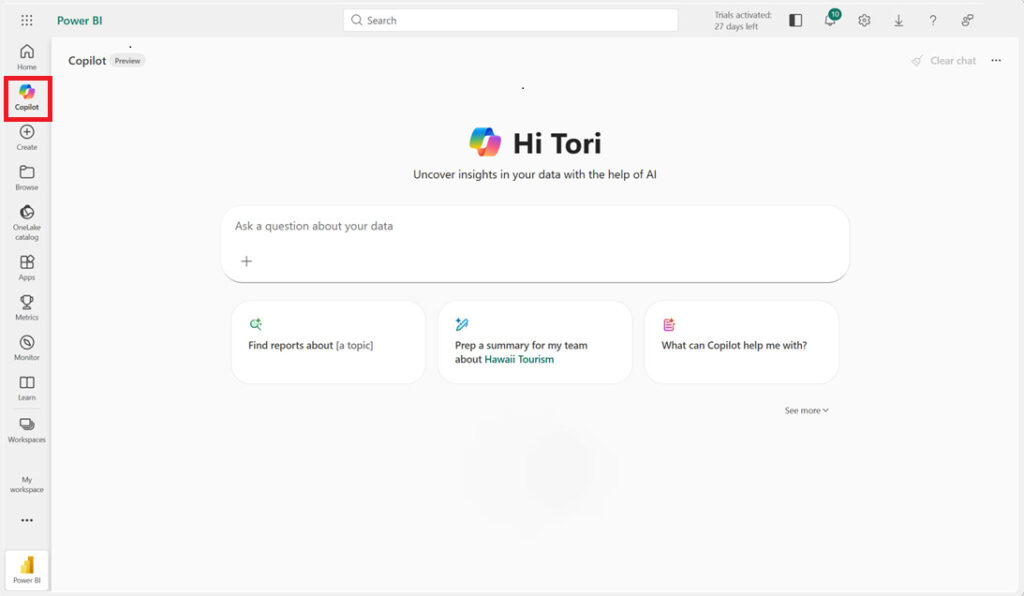
One of the biggest misconceptions in 2026 is that AI will eliminate the need for BI analysts. Microsoft’s own Copilot documentation shows a different story. Copilot helps with on-the-fly analysis, DAX generation, report summarization, and follow-up questions. Microsoft even frames these tasks as similar to what you might ask an analyst to do after reviewing a report. That means AI is an accelerator for Power BI workflows, not proof that Power BI is dead.
4. Power BI is tied to real job roles and certifications
Microsoft still maintains a recognized role-based certification for Power BI Data Analyst Associate, and it still describes the role in concrete business terms: preparing data, modeling data, visualizing insights, and managing Power BI. When a platform has a living certification ecosystem, it signals continuing professional demand
Is Power BI replaced by AI?
No, Power BI is not being replaced by AI. What is actually happening is more nuanced: AI is being embedded into Power BI. Microsoft’s Copilot features help users ask questions in natural language, generate summaries, assist with DAX, and speed up reporting. But AI still depends on clean data models, correct relationships, governance, business logic, and stakeholder context. Those parts still require a human analyst.
If anything, AI raises the value of skilled Power BI professionals because poor modeling plus AI equals faster mistakes. A company still needs a person who knows how to structure data, validate business metrics, and prevent misleading reports. In other words, AI does not remove the need for Power BI skills; it shifts the market toward better Power BI skills.
Is Power BI a good career option in 2026?
Yes, Power BI is still a good career option in 2026, especially for people entering analytics, MIS, reporting, operations analytics, finance analytics, and business intelligence roles. It is one of the most practical entry points because it sits between pure business users and deeper technical data roles. You do not need to become a data scientist on day one to get value from Power BI; you need to learn reporting logic, DAX, Power Query, and business storytelling.
Microsoft’s data analyst learning path describes analysts as professionals who maximize the value of data assets through visualization, reporting, cleaning, transformation, and effective data models. That is a highly employable skill set because businesses of all sizes need it.
Power BI is an especially strong option if you fall into one of these categories: a student wanting a faster job path, an Excel user who wants to level up, a junior professional switching from support or operations to analytics, or an IT professional who wants a business-facing data role. If you want broader career depth, pair Power BI with SQL training, Advanced Excel training, and a complete Data Analytics course.
Does Power BI have a future after 2026?
Yes, Power BI has a future after 2026 because the underlying business need is not going away. Companies will always need trusted reports, governed dashboards, executive summaries, and department-level analytics. Microsoft is also deepening Power BI’s role inside Fabric, which makes the platform even more central to analytics workflows rather than less central. [Source](https://www.microsoft.com/en-us/power-platform/products/power-bi)
Many searchers type the question in imperfect English—“Is Power BI have future?”—but the concern is the same. The real answer is that Power BI’s future depends less on the tool disappearing and more on how users adapt. If you only learn basic charts, your growth may stall. If you learn Power Query, DAX, SQL, Excel integration, data storytelling, and AI-assisted workflows, your Power BI profile becomes much more future-proof.
What Is the Salary for 5 Years Experience in Power BI in India?
A practical answer is this: for someone with around 5 years of Power BI experience in India, salary usually depends on whether the role is basic reporting, analyst-level BI, or true senior developer/consulting work. Public salary pages show that broad averages across all experience levels are lower, while senior Power BI developer profiles can move much higher. AmbitionBox pages for Power BI Developer and Senior Power BI Developer show a strong jump at senior levels, and company-specific salary entries also show variation by employer and role depth.
So, for content purposes, a realistic India-focused estimate for 5 years of Power BI experience would usually sit in a range like ₹8 LPA to ₹18 LPA, with stronger consulting, product, or domain-heavy profiles going above that. If you have advanced DAX, SQL, stakeholder communication, and domain expertise in finance, retail, healthcare, or operations, you are much more likely to land in the upper part of that band. Public pages from Glassdoor and AmbitionBox support the idea that specialization and seniority significantly improve pay.
| Experience Level | Typical Role Type | Practical India Salary View |
|---|---|---|
| 0–1 years | Junior Analyst / Reporting Executive | ₹4–7 LPA |
| 2–3 years | Power BI Analyst / Developer | ₹6–10 LPA |
| 4–5 years | Senior Analyst / Power BI Developer | ₹8–18 LPA |
| 6+ years | Lead BI Developer / Consultant / Manager | ₹12 LPA and above |
Note: Salary varies by city, domain, company type, communication ability, and project complexity. The band above is a practical SEO-friendly interpretation of current public market signals, not a guaranteed package.
What Is the Salary of Data Analyst in 2030?
No one can honestly promise an exact data analyst salary in 2030, because salaries depend on inflation, technology shifts, city, company, and specialization. But a smart estimate can be made from current trends. Naukri’s salary guidance for India shows entry-level analysts typically around ₹4–6 LPA, mid-level professionals around ₹7–15 LPA, and senior analysts at ₹15 LPA or more. If demand for analytics continues and professionals add BI, SQL, cloud, and AI skills, the stronger end of the market should keep rising by 2030.
The more practical takeaway for readers is this: do not optimize only for a 2030 salary number. Optimize for a 2030-ready skill stack. The analyst who only exports reports will be under pressure. The analyst who can connect data, clean it, model it, visualize it, explain it, and use AI responsibly will continue to earn well.
Is Power BI Going to Replace Excel?
No, Power BI is not going to fully replace Excel. These tools solve different problems. Excel is still excellent for quick calculations, ad hoc analysis, manual review, small models, and individual productivity. Power BI is better for scalable dashboards, refreshable reporting, interactive visualizations, data models, and sharing insights across teams. In many companies, the winning combination is Excel plus Power BI, not Excel versus Power BI.
This is actually good news for learners. If you already know Excel, Power BI becomes easier to understand conceptually. And if you add advanced spreadsheets to business intelligence skills, you become more employable. That is one reason it makes sense for learners in BTM to combine Power BI training with AllyTech’s Advanced Excel course in BTM.
| Tool | Best For | Weakness |
|---|---|---|
| Excel | Quick analysis, formulas, small datasets, manual reporting | Less scalable for enterprise dashboards |
| Power BI | Dashboards, modeling, automation, business reporting, storytelling | Needs learning curve for DAX and modeling |
| Using Both Together | Strongest practical business combination | Requires workflow discipline |
Is SAP Better Than Power BI?
This is the wrong comparison if you take it literally. SAP and Power BI are often used for different purposes. SAP is an enterprise business software ecosystem, while Power BI is primarily a business intelligence and reporting platform. In practice, many organizations use SAP as a source system and Power BI as the reporting and visualization layer on top of it. So the better question is not “Which is universally better?” but “Which role do you want?”
If you want a career in reporting, dashboards, data modeling, and business insights, Power BI is the more direct path. If you want ERP-focused functional or technical roles, SAP may be more suitable. For many learners, Power BI is the faster and more flexible entry point into analytics because it applies across industries and departments, not just SAP-heavy environments.
What Are the Top 3 Skills for a Data Analyst in 2026?
1. SQL
SQL is still the core language for pulling, filtering, joining, and validating data. Even excellent Power BI users become limited if they cannot understand data sources properly. That is why a strong analytics path should include SQL alongside dashboards. Microsoft’s Power BI role definition also reflects the importance of preparing and acquiring data effectively.
2. Power BI and data visualization
Modern businesses need people who can present data clearly. That means building dashboards, writing DAX, using Power Query, choosing the right charts, and creating reports that executives can trust. Visualization is no longer optional; it is how analysis becomes business action.
3. Business thinking and communication
The best analysts do not just build reports. They explain what the numbers mean, ask the right stakeholder questions, and link data to decisions. This is why two professionals with the same technical skill can have very different salary outcomes. Communication lifts an analyst into a decision-support role.
If you want a practical sequence, start with Advanced Excel, then SQL, then Power BI, and finally a broader Data Analytics course for portfolio-building.
A Smart 2026 Learning Roadmap for Power BI Beginners
If your goal is to rank in the job market, not just pass a quiz, learn in this order: Excel basics, SQL fundamentals, Power Query, data modeling, DAX, dashboard design, storytelling, and interview projects. Then add AI-assisted analytics features so you know how modern teams work. Microsoft’s own Power BI learning and certification path aligns with this real-world progression.
The key is not to learn Power BI in isolation. Power BI becomes powerful when paired with SQL, Excel, and business context. That is why students who build end-to-end mini-projects—sales dashboard, finance KPIs, HR analytics, marketing performance—tend to interview better than learners who only memorize visuals.
Why AllyTech Is Considered as the Best Institute of Power BI Training in BTM Area
On its Power BI course page, AllyTech highlights a curriculum built around Power BI fundamentals, Power Query, DAX, data modeling, dashboard development, mobile optimization, and real-world projects such as sales performance, financial KPIs, HR analytics, supply chain dashboards, and marketing performance tracking. That is exactly the kind of practical structure a beginner needs in 2026.
AllyTech also presents flexible batches for students and working professionals, small-batch attention, hands-on labs, and placement support with resume building, mock interviews, LinkedIn guidance, and job referrals. For learners in South Bangalore, these are not minor details. They directly affect whether the course leads to interview confidence.
The About Us page further strengthens credibility by emphasizing practical data education, project-based learning, Bangalore job market alignment, and a broader analytics curriculum that includes Power BI, SQL, Excel, and advanced topics. The site also states 500+ students trained and a 94% placement rate, which adds persuasive local trust signals for prospective learners.
If a learner asks, “What should I do after reading an article on whether Power BI is still in demand in 2026 and after 2026?”, the most sensible internal path is to compare the Power BI course in BTM with the SQL course in BTM, the Advanced Excel course in BTM, and the Data Analytics course in BTM. You can also review About Us, browse all courses, check locations, or contact AllyTech directly
Why the BTM Location Matters for Power BI Learners
Local relevance is an important ranking factor for service-based education pages. AllyTech’s training center is positioned in the BTM and Bannerghatta Road belt of South Bengaluru, which makes it highly relevant for learners from BTM Layout, Jayanagar, Bannerghatta Road, and nearby commuting zones. This area is familiar to students and professionals coming through landmarks such as Jayadeva Hospital, Vega City Mall, and the IIM Bangalore side of South Bangalore.
Who Should Learn Power BI in 2026?
You should seriously consider Power BI if you are a student from BCom, BBA, BCA, BSc, BTech, MBA, or MCA backgrounds; a working professional in MIS, finance, operations, support, or reporting; or a job seeker who wants a realistic path into analytics without waiting years to become a specialist data scientist. Power BI is also ideal for Excel-heavy professionals who want to move into dashboarding and modern BI.
You may want a broader path if your target role is heavy backend engineering, advanced machine learning research, or ERP specialization. But even in those cases, reporting and business communication skills remain useful. Power BI is rarely wasted learning.
Final Verdict: Is Power BI Still in Demand in 2026 and After 2026?
Yes—Power BI is still in demand in 2026 and after 2026. The demand is supported by Microsoft’s ongoing investment, the continuing need for business intelligence, active job-market signals, and the fact that AI is enhancing Power BI rather than making it irrelevant. For learners in India, especially in Bangalore, Power BI remains one of the most practical and job-oriented data skills to learn—provided you learn it the right way, with SQL, Excel, DAX, projects, and business context. [Source](https://www.microsoft.com/en-us/power-platform/products/power-bi) [Source](https://learn.microsoft.com/en-us/power-bi/create-reports/copilot-introduction) [Source](https://in.linkedin.com/jobs/power-bi-jobs) [Source](https://www.naukri.com/powerbi-jobs)
If you are located in BTM, Jayanagar, or Bannerghatta Road and want a career-focused learning path, AllyTech gives you a strong local option with practical training, analytics-oriented course structure, and multiple supporting programs that strengthen Power BI outcomes. Start by visiting the Power BI course page or contacting AllyTech for batch details.
If you’re weighing this decision purely from a 2026 lens — comparing Power BI against newer AI-native BI tools before committing budget or training time — we’ve broken that specific question down in more depth, including a full industry-by-industry comparison and the latest Power BI job market data for 2026. It complements the longer-term view here with a sharper, present-day snapshot of demand.
Frequently Asked Questions About Power BI Demand in 2026
Is Power BI still in demand in 2026 and after 2026?
Yes. Power BI remains in demand because companies still need dashboards, reporting, self-service analytics, and business insight generation. Microsoft is actively investing in the platform and its Fabric integration.
Is Power BI replaced by AI?
No. AI features such as Copilot are designed to assist Power BI users with analysis, summarization, and DAX help, not replace skilled analysts entirely.
Is Power BI a good career option?
Yes. It is one of the best practical entry points into analytics, reporting, BI, and business-facing data roles.
Is Power BI going to replace Excel?
No. Excel and Power BI complement each other. Excel is strong for quick analysis; Power BI is stronger for interactive dashboards and scalable reporting.
Is SAP better than Power BI?
Not universally. SAP and Power BI often serve different functions. Many companies use SAP as the data source and Power BI as the reporting layer.
What are top 3 skills for a data analyst?
SQL, Power BI/data visualization, and business communication are the top three practical skills to prioritize.
What is the salary for 5 years experience in Power BI in India?
A practical market range is often around ₹8–18 LPA, depending on company, city, domain knowledge, and project depth.
What is the salary of data analyst in 2030?
No exact figure can be guaranteed, but professionals with strong BI, SQL, reporting, and AI-assisted analytics skills are more likely to command premium salaries by 2030.
Contact AllyTech for Power BI Training in BTM, Bangalore
AllyTech- Adv. Excel & Macros / Data Science / SAP Training in btm Bannerghatta Rd Jayanagar
Address: B-1, Bannerghatta Slip Road, KEB Colony, New Gurappana Palya, 1st Stage, BTM Layout 1, Bengaluru, Karnataka 560029
Call: 074110 11500
Website: https://allytechservices.in/