
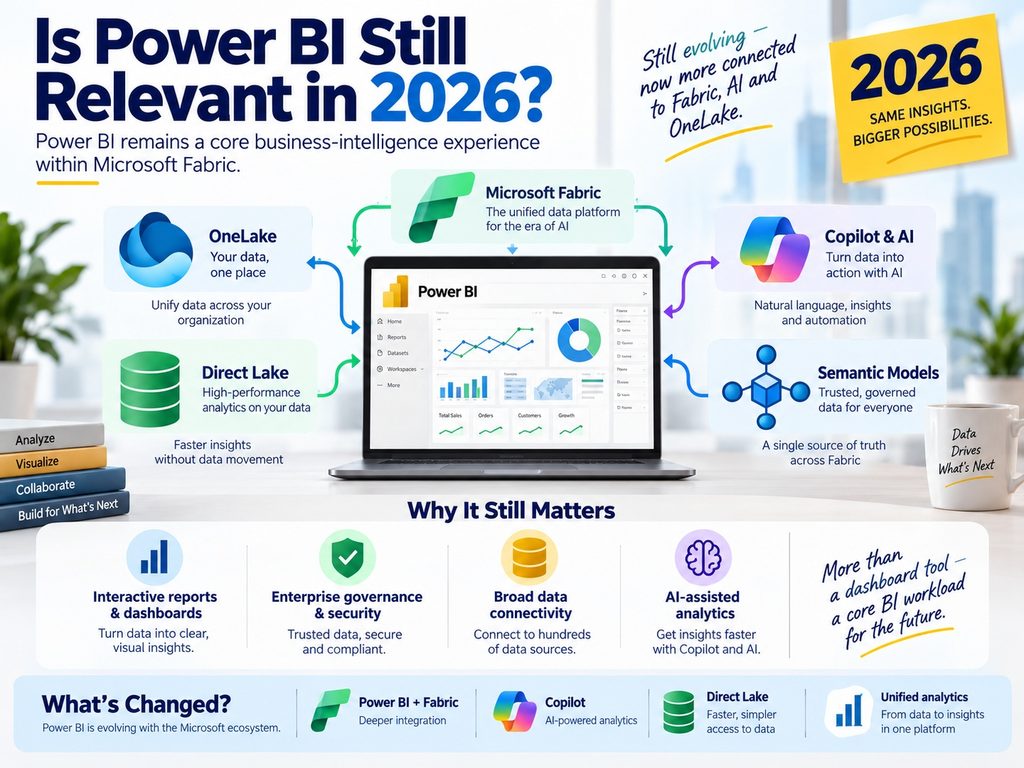
Is Power BI Still Relevant in 2026? Here’s the Data-Backed Answer
Is Power BI still relevant in 2026? If you’re a business owner asking this question before investing in a BI tool or training your team, the short answer is yes — and the data behind that answer is more convincing than most people realize. Microsoft’s Power BI hasn’t just survived the AI disruption sweeping through analytics software; it has absorbed it, embedding Copilot, Microsoft Fabric, and agentic AI directly into the platform millions of businesses already use.
In this guide, we’ll break down exactly why Power BI is still relevant in 2026, back it up with market data and job trends, compare it honestly against competitors, walk through real use cases across departments, and show you what it means for your business — whether you’re evaluating BI tools for the first time or considering upskilling your existing team.
Why Business Owners Are Asking “Is Power BI Still Relevant in 2026?”
Every year, a wave of new AI-powered analytics startups claims to be the “Power BI killer.” Business owners understandably want to know if the tool they’ve invested in — or are about to invest in — will still be standing in a few years. Budget cycles, training decisions, and hiring plans all hinge on getting this answer right. Get it wrong, and you either overspend on a niche tool your next analyst won’t know how to use, or you underinvest and fall behind competitors already automating their reporting.
This concern is valid, but the evidence tells a different story than the hype. For the eighteenth consecutive year, Microsoft has been positioned as a Leader in the Gartner Magic Quadrant for Analytics and Business Intelligence Platforms, and for the seventh straight year, it leads on both Completeness of Vision and Ability to Execute — the two axes that decide market leadership. That’s not a legacy tool coasting on reputation. That’s continuous, compounding dominance in a fast-moving category, re-earned every single year against dozens of well-funded challengers.
Power BI Career Scope in 2026: What the Job Market Actually Shows
If you’re wondering whether to train your team on Power BI or hire for the skill, the job market gives a clear signal. Job postings requiring Power BI skills have grown roughly 25% year-over-year in the business analytics field, and Power BI now appears in close to a quarter of all data-analyst job listings alongside SQL and Excel as a baseline expectation, not a bonus skill.
This is the heart of the Power BI career scope in 2026 conversation: companies aren’t just tolerating Power BI, they’re actively hiring for it — from junior data analysts building their first dashboard to senior BI developers architecting Microsoft Fabric pipelines. Recruiters in Bangalore’s IT corridor report Power BI listed as a required or preferred skill in the majority of data-analyst and business-analyst openings, spanning industries from banking to pharma to e-commerce.
Another factor that keeps answering is Power BI still relevant in 2026 with a firm yes is how tightly it’s tied to procurement reality. Most Indian businesses aren’t choosing BI tools in a vacuum — they’re choosing them inside an existing Microsoft 365 subscription, where Power BI is often already partially paid for. That’s a structural advantage no competitor can undercut with pricing alone, and it’s a big reason IT decision-makers keep renewing rather than migrating.
Is Power BI Still Relevant in 2026? The Market Numbers Say Yes
Let’s look at the raw numbers, because numbers don’t lie the way marketing copy does.
| Metric | Data Point | Source |
|---|---|---|
| Gartner Magic Quadrant Leader | 18 consecutive years | Gartner / Microsoft |
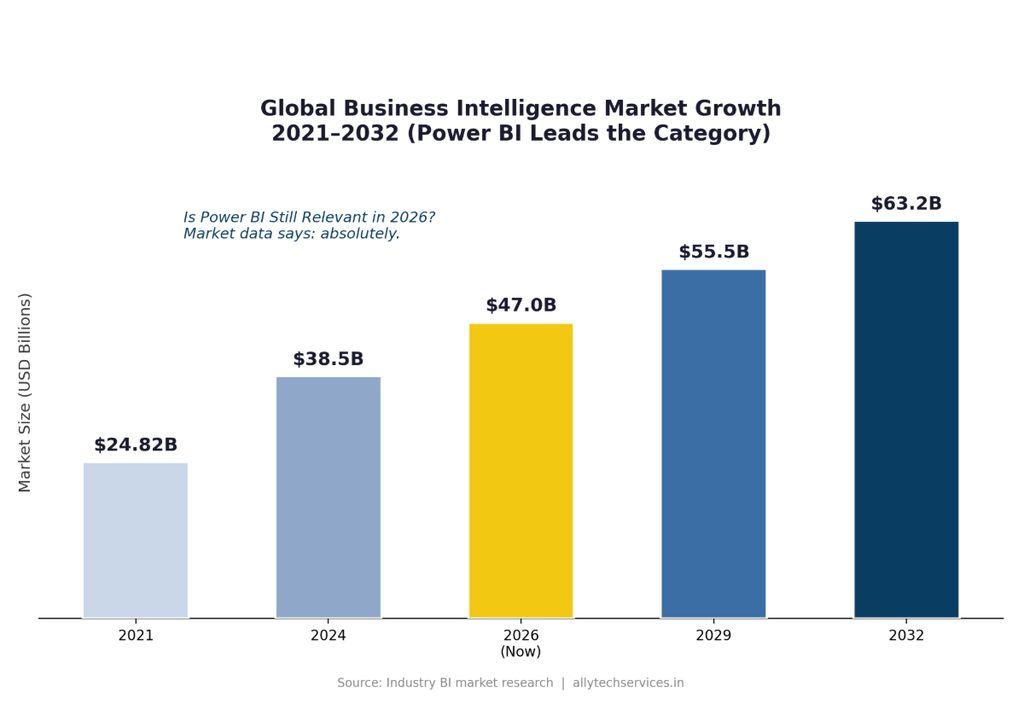
| BI Market Size (2021) | $24.82 Billion | Industry market research |
| BI Market Size (2032, projected) | $63.2 Billion | Industry market research |
| Power BI job posting growth | ~25% YoY | Business analytics hiring data |
| Analytics decisions made in Power BI | ~3 out of 10 enterprise decisions | Industry analysis |
| Consecutive years as Forrester Wave Leader | 2025 (again) | Forrester Wave: BI Platforms Q2 2025 |
| Generative AI functionality score | Highest of any vendor evaluated | Forrester Wave Q2 2025 |
The business intelligence market itself is projected to nearly triple between 2021 and 2032, and Power BI is capturing a disproportionate share of that growth because of its deep integration with Microsoft 365, Azure, and Fabric — tools most businesses already run on. That embedded-by-default position is precisely why Power BI’s relevance is structural rather than trend-driven: displacing it means replacing an organization’s entire data stack, not just swapping one app.
Not sure how BI fits your business? Talk to Ally Tech Services for a free consultation on the right analytics path for your team.
Power BI vs. Other BI Tools in 2026: An Honest Comparison
To answer is Power BI still relevant in 2026 fairly, we need to compare it against the alternatives business owners actually consider before making a decision.
| Feature | Power BI | Tableau (Salesforce) | Google Looker |
|---|---|---|---|
| Gartner Leader status (2025) | ✅ Leader, 18th year | ✅ Leader | ✅ Leader |
| Microsoft 365 / Excel integration | ✅ Native | ⚠️ Limited | ⚠️ Limited |
| AI Copilot / GenAI scoring | ✅ Highest of any vendor (Forrester Q2 2025) | ✅ Strong | ✅ Strong (Gemini) |
| Cost for small businesses | ✅ Most cost-effective | ⚠️ Higher | ⚠️ Higher |
| Ease of learning for non-tech teams | ✅ High | ⚠️ Moderate | ⚠️ Moderate |
| Data modeling depth (DAX) | ✅ Very strong | ⚠️ Moderate | ✅ Strong (LookML) |
| Best fit | SMBs & enterprises on Microsoft stack | Enterprise visual analytics | Google Cloud-native businesses |
The takeaway: Power BI isn’t winning by default — it’s winning on cost, ecosystem integration, and AI capability, three things business owners actually care about when choosing a tool for the next five years, not just the next financial quarter.
Where Power BI Genuinely Falls Short
An honest answer to is Power BI still relevant in 2026 has to acknowledge its limits, too. Power BI can feel less polished for highly custom, pixel-perfect visual storytelling compared to Tableau, and organizations fully committed to Google Cloud sometimes find Looker’s native BigQuery integration smoother. Very large, real-time streaming datasets can also push teams toward DirectQuery or Fabric-native solutions rather than simple imports. None of these gaps make Power BI obsolete — they just mean the “right tool” question still depends on your existing tech stack, which for most Indian SMBs and Microsoft-365 businesses still points firmly toward Power BI.
7 Reasons Power BI Is Still Relevant in 2026
1. Deep Microsoft Fabric Integration
Power BI is no longer a standalone visualization tool — it’s the front end of Microsoft Fabric, Microsoft’s unified data platform. This means your reports, pipelines, warehouses, and AI models now live in one ecosystem instead of five disconnected tools stitched together with manual exports. For a business owner, that translates into fewer integration headaches and a lower total cost of ownership.
2. Power BI Career Scope in 2026 Keeps Expanding, Not Shrinking
New specializations have opened up around Power BI: Fabric architecture, Copilot governance, DirectQuery optimization, and Row-Level Security (RLS) design. These aren’t entry-level tasks — they’re mid-to-senior roles commanding premium salaries, which means the ceiling for a Power BI career has actually risen rather than plateaued.
It’s also worth noting how the Power BI career scope in 2026 differs by experience level. Freshers are landing entry-level analyst roles by mastering Power Query and basic DAX within a few months of training. Mid-career professionals are commanding higher packages by adding Fabric and Copilot governance to their skillset. And senior consultants are increasingly billed as fractional BI architects for multiple SMB clients at once — a role that barely existed three years ago.
3. Cost-Effective for Small and Mid-Sized Businesses
Compared to enterprise-only BI suites, Power BI’s per-user licensing and bundling with Microsoft 365 make it dramatically more accessible for Indian SMBs scaling their first data function. Many businesses already own the license through their existing Microsoft subscription and simply haven’t activated it yet.
4. AI Copilot Reduces the Technical Barrier
Business users can now ask questions in plain English and get dashboards back, lowering the skill floor for non-technical teams while still rewarding advanced DAX and data-modeling expertise for specialists. This dual accessibility — easy for beginners, deep for experts — is rare among BI tools and is a major reason adoption keeps climbing.
5. Massive, Active Community and Talent Pool
Because so many companies use Power BI, hiring, training, and vendor support are easier to find than for niche BI tools — a practical advantage business owners underestimate until they need to hire fast or troubleshoot a broken report on a deadline.
6. Continuous Product Investment from Microsoft
Microsoft’s consistent Gartner and Forrester leadership signals sustained R&D investment, not a product being sunset or deprioritized. Major updates now ship monthly, with entire conferences (like the Fabric Community Conference) dedicated solely to the platform’s roadmap.
7. It Answers “Is Power BI Still Relevant in 2026” With Real ROI
Businesses report faster decision cycles and reduced reporting overhead after Power BI adoption, translating directly into cost savings — the ultimate test of relevance for any business tool. When finance, sales, and operations teams can self-serve their own reports instead of waiting on a data team, the ROI compounds month over month.
Real-World Use Cases: How Bangalore Businesses Are Using Power BI in 2026
Beyond the statistics, it helps to see where Power BI actually shows up inside a growing business:
- Sales teams track pipeline velocity and territory performance in real time instead of waiting for a weekly Excel roll-up.
- Finance departments build automated P&L and cash-flow dashboards that refresh overnight, cutting month-end closing time.
- Operations managers monitor inventory, logistics, and vendor SLAs across multiple locations from a single connected dashboard.
- HR teams track attrition, hiring funnels, and workforce cost trends without exporting data to spreadsheets manually.
- Marketing teams blend ad-spend data from multiple platforms into one unified ROI view.
Each of these use cases reinforces the same conclusion: Power BI’s relevance in 2026 isn’t theoretical — it’s showing up in the daily operating rhythm of businesses across nearly every function.
Power BI Career Scope in 2026: Top Job Roles to Know
If your team — or you personally — are considering upskilling, here’s where Power BI skills lead in 2026:
- Business Intelligence (BI) Analyst
- Data Analyst
- Power BI Developer
- Data Visualization Specialist
- Business Analyst
- Data Engineer (Power BI specialization)
- Power BI Consultant / Freelancer
- Project Manager (with BI expertise)
Each of these roles is actively hiring in Bangalore’s growing tech and analytics corridor, particularly around BTM Layout, Jayanagar, JP Nagar, and Bannerghatta — hubs with a dense concentration of IT, analytics, and consulting firms.
Ready to build these in-demand skills? Explore the Power BI Course in BTM at Ally Tech Services and start your journey into a high-growth analytics career.
Is Power BI Still Relevant in 2026 for AI-Driven Businesses?
A common misconception is that generative AI tools will replace dashboards entirely. In reality, AI and Power BI are converging, not competing. Copilot for Power BI now handles natural-language queries, automated insight generation, and even DAX-writing assistance — meaning the tool is getting more powerful, not obsolete, as AI matures.
This is precisely why Power BI remains relevant in 2026: it isn’t resisting the AI shift, it’s the delivery layer for it. Businesses using Power BI today are, in effect, already using enterprise-grade AI analytics without needing a separate AI vendor or a costly custom build. As agentic AI features roll out further through 2026, expect Power BI to shift from “a tool you query” toward “a system that proactively surfaces insights before you ask” — a trajectory that strengthens, rather than threatens, its relevance.
How Business Owners Should Act on This in 2026
Here’s a simple framework if you’re still deciding:
- If you’re on the Microsoft 365 stack — Power BI is very likely your most cost-effective, best-integrated BI option, and you may already be paying for licenses you aren’t using.
- If you’re hiring analysts — expect Power BI to be a baseline requirement, not a differentiator, so prioritize DAX, Fabric, and Copilot skills when screening candidates.
- If you’re upskilling your team — a structured Data Analytics Course that covers Power BI alongside SQL and Advanced Excel gives your team a complete, job-ready skill stack rather than a single-tool skill.
- If you’re budgeting for 2026 — factor in that Power BI’s continued Gartner/Forrester leadership makes it a lower-risk, longer-horizon investment than a newer, unproven BI startup.
Explore all courses at Ally Tech Services — including Advanced Excel, SQL, and AI & ML — to build a future-proof analytics career or team.
Is Power BI still relevant in 2026 – Frequently Asked Questions
Is Power BI still relevant in 2026?
Yes. Power BI remains the Gartner-recognized market leader in business intelligence for the 18th consecutive year, with growing job demand, deepening Microsoft Fabric integration, and AI Copilot features that keep it central to enterprise analytics.
Will AI replace Power BI?
No — AI is being built directly into Power BI through Copilot, making the tool more powerful rather than replacing it. Power BI is increasingly the interface through which businesses access AI-driven insights.
Is it still worth learning Power BI in 2026?
Yes. With Power BI appearing in a large share of data-analyst job postings and salaries rising for Fabric and DAX specialists, the Power BI career scope in 2026 remains strong for both freshers and experienced professionals.
What’s the best way to learn Power BI in Bangalore?
A structured, project-based course covering Power Query, DAX, data modeling, and Microsoft Fabric basics — such as the Power BI Course in BTM at Ally Tech Services — gives learners job-ready, portfolio-level skills.
Is Power BI better than Tableau in 2026?
For businesses already on Microsoft 365 or Azure, Power BI generally offers better integration and lower cost. Tableau remains strong for advanced, standalone visual analytics. Both are current Gartner Leaders, so the right choice depends on your existing tech stack.
How long does it take to learn Power BI?
Most learners can reach a job-ready foundational level — Power Query, basic DAX, and dashboard building — within 6 to 10 weeks of structured, project-based training, with advanced Fabric and DAX specialization taking longer.
Final Verdict: Is Power BI Still Relevant in 2026?
Based on Gartner’s 18-year leadership streak, a nearly tripling global BI market, and 25% year-over-year job growth for Power BI skills, the evidence strongly confirms that Power BI is still relevant in 2026 — arguably more relevant than ever, given its role as the delivery layer for enterprise AI. For business owners, the real question isn’t whether to invest in Power BI, but how quickly you can build the in-house skills to use it well before competitors do.
Small business owners sometimes assume Power BI is overkill until they’re already enterprise-sized — but that thinking gets the timing backwards. The businesses seeing the fastest ROI in 2026 are the ones that adopted Power BI early, while their data volume was still small enough to build clean dashboards from scratch, rather than retrofitting years of messy spreadsheets later. Starting early is what makes the Power BI career scope in 2026 and the business case for adoption reinforce each other.
Want a team that can actually use Power BI to grow your business? Contact Ally Tech Services today or explore our Power BI training locations across Bangalore — including BTM 1st Stage, BTM 2nd Stage, BTM 3rd Stage, Jayanagar, JP Nagar, and Bannerghatta.
About the Author
This article was researched and published by the Ally Tech Services team — Bangalore-based Power BI, SQL, and Data Analytics trainers with hands-on, real-project teaching experience across multiple Bangalore locations. Read more about our trainers and government-recognized certifications. Learn more about us, or explore career opportunities in analytics.
Last Updated: September 2026 | Reviewed for accuracy against Gartner Magic Quadrant 2025 and Forrester Wave Q2 2025 reports.
Related Reading: Is Power BI Still in Demand in 2026 and After 2026? (Pillar Guide)
External Sources / Further Reading: