
There’s a specific frustration that shows up among job seekers from South Bangalore’s IT corridor — Arakere, Bannerghatta Road, BTM, and surrounding areas. It goes like this: “I know what SQL is. I’ve done tutorials. But I’m still not clearing the technical round.”
This is one of the most common things we hear from learners who come to AllyTech before enrolling. And it almost always has the same root cause — knowing SQL syntax is not the same as being able to apply SQL under interview conditions, on unfamiliar data, with a hiring manager watching.
If you’re looking for SQL training near Arakere that solves this specific problem — not just teaches you commands, but builds the applied problem-solving ability that interviews actually test — this is what AllyTech’s SQL programme in BTM Layout is built to do.
📞 Phone / WhatsApp: 074110 11500 📧 Email: info@allytechservices.in 📋 Reserve your free demo class: Contact Us
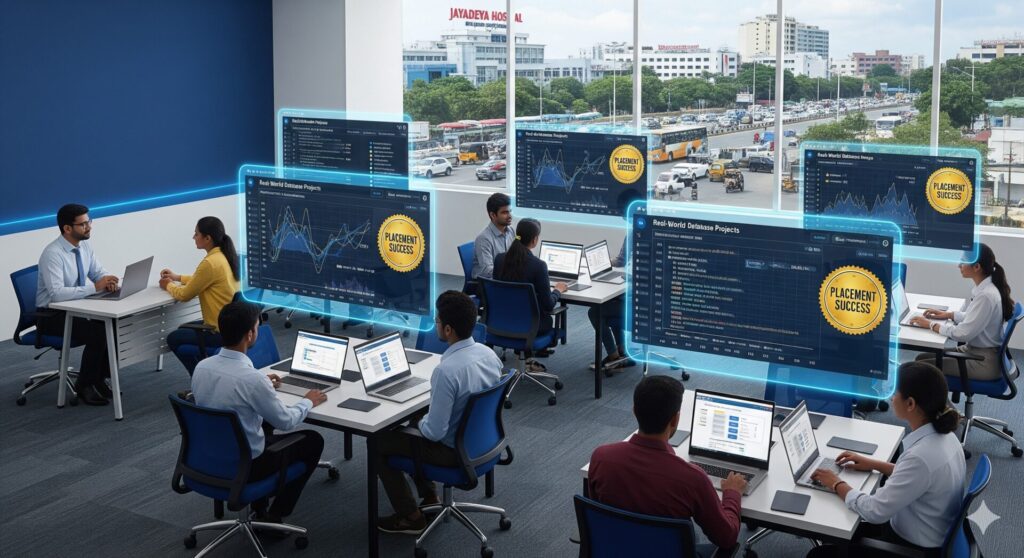
What Bangalore Hiring Managers Actually Test — and Why Most Candidates Fall Short
Understanding what interviewers are evaluating helps you train with the right focus. Based on what our learners report from technical screens across Bangalore companies — product firms, IT services, analytics agencies, and MNCs — here’s what consistently decides outcomes:
Round 1 — Basic filtering and aggregation. Most candidates handle this. SELECT, WHERE, GROUP BY, HAVING. If you’ve done any SQL tutorial, you’ll get through this. It’s the floor, not the ceiling.
Round 2 — Multi-table joins on an unfamiliar schema. This is where elimination begins. The interviewer gives you two or three tables you’ve never seen before and asks you to produce a result that requires combining them correctly. Candidates who have only practised on familiar toy datasets freeze here. The ones who pass are those who have trained on varied, unpredictable schemas — which is exactly how we structure practice at AllyTech.
Round 3 — Subqueries, CTEs, and query structuring. At this stage, interviewers are evaluating two things simultaneously: whether you can get the right answer, and whether you can explain your logic clearly. A correct query you can’t explain is often scored lower than a nearly-correct query with clear reasoning. We train both skills deliberately.
Round 4 — Window functions. This is the clearest differentiator between candidates. Window functions test whether your SQL thinking is intermediate-to-advanced. Interviewers use ranking problems, running totals, and period-comparison questions here. Candidates who haven’t specifically trained on these don’t just struggle — they often have no starting point at all.
Knowing this progression, our SQL course is structured to build genuine competence at every stage — not surface-level familiarity with all of them.
How AllyTech Builds Interview-Ready SQL Ability
Building the Right Fundamentals First
We spend more time on fundamentals than most candidates expect — and for good reason. At AllyTech, we’ve found that the learners who struggle with joins and window functions almost always have a gap at the fundamentals stage that they weren’t aware of. Specifically: they know the syntax of GROUP BY but don’t fully understand what grouping does to the data, which means their intuition breaks down the moment the problem gets more complex.
We fix this with deliberate practice on:
- SELECT, WHERE, ORDER BY — not just syntax, but learning to think about data retrieval as a filtering process
- GROUP BY and HAVING — understanding aggregation at the row level versus the group level
- NULL handling — one of the most underestimated topics; NULL behaviour in joins, aggregates, and filters trips up even experienced candidates
- Aggregate functions in context — COUNT, SUM, AVG, MIN, MAX applied to realistic datasets, not abstract examples
- DISTINCT and data sampling — understanding when and why you’d use them, not just that they exist
Joins — Practised Until They’re Instinctive
Joins are non-negotiable. Every SQL interview tests them. Every data role uses them daily. And the reason so many candidates struggle isn’t that joins are inherently difficult — it’s that they’ve only ever practised on clean, simple, purpose-built examples.
Real-world data is messy. Join keys aren’t always obvious. Results sometimes contain unexpected NULLs or duplicate rows that reveal a misunderstood relationship. At AllyTech, we use datasets that reflect this messiness deliberately, so that by the time you sit for an interview, you’ve already encountered and solved the kinds of surprises that cause candidates to stall.
We cover every join type with applied problems: INNER, LEFT, RIGHT, FULL OUTER, SELF, and CROSS joins — including the tricky scenarios like self-referential tables and three-way joins that appear in case studies for analyst roles.
CTEs — Learning to Think Before You Type
Common Table Expressions changed how professional analysts write SQL. Instead of one deeply nested, unreadable query, a CTE-based approach breaks the logic into named steps — each building on the last. The result is SQL that is easier to debug, easier to explain, and much easier for an interviewer to follow.
We teach the CTE mindset, not just the syntax. That means: before writing a single line of code, you identify the logical steps your query needs to take. This habit — thinking in layers — is what our learners consistently say made the biggest difference in their interview confidence.
Window Functions — The Skill That Closes the Gap
Here is a practical reality of Bangalore’s data hiring market: most candidates applying for Data Analyst, MIS Executive, and Reporting Analyst roles do not know window functions well. This means that if you do, you stand out clearly. It’s one of the fastest ways to move from shortlisted to selected.
We teach window functions through problems that mirror exactly what companies test:
- ROW_NUMBER, RANK, DENSE_RANK — ranking employees by salary, products by revenue, customers by order value; understanding when each behaves differently
- Running totals and cumulative sums — building financial summaries and progress tracking reports
- LEAD and LAG — comparing a row to the one before or after it; essential for month-over-month analysis and churn detection
- “Latest record per group” — extracting the most recent transaction, status, or entry per customer or category; one of the most frequently tested SQL patterns in Bangalore interviews
- Partitioned aggregations — using window functions to calculate group-level metrics without collapsing rows, a powerful technique for analytics reporting
Each of these is practised on multiple problem types until the approach becomes second nature — not memorised, but genuinely understood.
From Arakere to BTM — A Practical Commute for Serious Training
Arakere sits on Bannerghatta Road, one of South Bangalore’s most directly connected corridors. AllyTech’s training centre in BTM Layout is approximately 10 minutes from Arakere by road — a straightforward commute without crossing central Bangalore traffic.
For learners along the Bannerghatta Road belt — Arakere, Gottigere, Hongasandra, JP Nagar — BTM Layout is the most accessible South Bangalore option for quality SQL training. We run both weekday and weekend batches, so whether you’re a full-time student working toward placements or a working professional training alongside a job, there’s a schedule that fits.
Before you commit to any batch, you can attend a free demo class — no enrollment, no deposit. Sit through a session, see how we teach, and evaluate the pace and approach for yourself. Book your demo here.
Review our instructors’ backgrounds and industry experience before enrolling: Our Trainers
SQL as Part of a Larger Analytics Skill Set
SQL is the foundation. Once you’re confident with it, the next layer of your data analytics skill set determines how competitive you are for the roles that pay well in Bangalore’s analytics market.
Advanced Excel is where your SQL output becomes a polished, stakeholder-ready report. Pivot tables, dynamic summaries, XLOOKUP, and Macro-driven automation — these are what turn raw query results into business deliverables.
Power BI connects directly to SQL databases and transforms your data into interactive dashboards. This SQL + Power BI combination is explicitly listed as a requirement in a large proportion of Data Analyst job descriptions across Bangalore right now.
Data Analytics develops the business thinking layer — how to frame a problem, design metrics, and present findings in a way that makes your technical output commercially useful. This is what separates analysts who grow in their careers from those who stay in execution-only roles.
For complete course details, batch options, and the full SQL syllabus: SQL Course in BTM
Recommended Resources for Daily Practice
The learners who progress fastest between sessions are those who practise every day, even if only briefly. Three resources we consistently recommend:
W3Schools SQL Tutorial — Use this for drilling syntax and running quick exercises between sessions. The interactive format gives you immediate feedback, which is valuable for catching small errors in your query logic.
Microsoft SQL Server Documentation — When you encounter a function or behaviour you don’t fully understand, go to the official documentation rather than guessing. Building this habit early saves significant debugging time later.
Stack Overflow SQL Tag — Browse real SQL problems posted by working developers and analysts. Even reading through questions and answers — without solving them yourself — builds a fast-expanding vocabulary of real-world SQL scenarios.
Key Internal Links (Your Learning Path)
Primary Course Page:
SQL Course in BTM – Full syllabus, batch details, and enrollment
Supporting Courses:
Institute Info:
Daily Practice Resources (Outbound Links)
To accelerate your learning, use these trusted resources:
- W3Schools SQL Tutorial – Interactive exercises and examples
- Microsoft SQL Server Documentation – Official technical reference
- Stack Overflow SQL Questions – Real-world problem solving and community support
Service Areas We Serve (South Bangalore)
We support learners from nearby South Bangalore locations, including:
BTM Layout | Jayanagar | JP Nagar | Bannerghatta | Madiwala | Silkboard | Arakere
Whether you’re commuting from Arakere or nearby areas like Silk Board and Madiwala, AllyTech’s BTM Layout center is accessible and convenient.
Visit or Contact Us
AllyTech Services B-1, Bannerghatta Slip Road, KEB Colony, New Gurappana Palya, 1st Stage, BTM Layout 1, Bengaluru, Karnataka 560029
📞 Phone / WhatsApp: 074110 11500 📧 Email: info@allytechservices.in 🔗 Enquire about batch timings, fees, and demo availability
Serving learners from: Arakere · BTM Layout · Bannerghatta · Madiwala · Silk Board · JP Nagar · Jayanagar · Gottigere · Hongasandra
→ Attend a free demo — no commitment: Contact Us → Full SQL course details and syllabus: SQL Course in BTM
We do not make placement guarantee claims. Our focus is on building the technical ability that makes placement outcomes more likely.
Next-Step CTA
Call / WhatsApp / Form
Ready to start your SQL journey?
→ Get the syllabus + book a demo: Contact Us
→ View course details first: SQL Course in BTM
FAQs – SQL Training Near Arakere (Bangalore)
1) Is this SQL training suitable for absolute beginners from Arakere?
Yes. A beginner-friendly SQL training starts with fundamentals and quickly builds confidence through structured practice, hands-on assignments, and interview-oriented question patterns.
2) What is the most important SQL topic for job interviews?
Joins are usually the first filter in technical interviews, followed by GROUP BY/HAVING, subqueries/CTEs, and window functions. These are the skills that separate candidates in screening rounds.
3) I’m in Arakere—can I attend if the center is in BTM Layout?
Yes. Learners from Arakere commonly choose nearby South Bangalore locations like BTM for convenience, accessibility, and batch flexibility. The commute from Arakere to BTM is short and well-connected.
4) Do you teach SQL specifically for analytics roles (Data Analyst / MIS)?
A job-focused SQL course teaches you to extract, clean, combine, and summarize data for reporting and dashboards—exactly the skills used in Data Analyst and MIS roles.
5) How do I know whether a course is practical and not just theory?
Check whether the course includes hands-on assignments, real-world case studies, and interview-style practice problems (especially joins and window functions).
6) Do you provide a demo class before enrollment?
You can confirm demo class availability and the latest batch options by contacting the team here: Contact Us
7) How long does it take to become confident in SQL?
With consistent daily practice, most learners get comfortable with SQL basics quickly, then build confidence in joins, CTEs, and window functions over the next few weeks.
8) What should I learn after SQL to improve my job chances in Bangalore?
A common learning path is SQL + Advanced Excel + Power BI, then add analytics fundamentals for end-to-end reporting skills. Related courses: Advance Excel, Power BI, Data Analytics.
9) Do you provide certificates or recognition information?
If certification and recognition matter to you, review AllyTech’s published recognition information here: Recognition
10) What is the best way to practice SQL daily?
Use an interactive tutorial like W3Schools SQL, official Microsoft SQL documentation, and troubleshoot real problems using Stack Overflow’s SQL tag.
Compliance Note
We avoid claims like “100% Placement Support” on this page to maintain transparency and realistic expectations.